About troveGEN
Retrieval is where RAG fails. We built the part that works.
troveGEN comes from Intellara Technologies, a product studio in Bengaluru. It began as the retrieval layer of a live product, where wrong passages were not an option, and we turned it into something any team can use.
Our story
From one product that had to be right, to a stack for everyone.
- 2025
A product that had to get answers right
Intellara Technologies started in Bengaluru as an AI product studio. One of our first clients, AstroReeti, answers questions from classical texts in many languages, so a wrong passage is not a small mistake. It is a wrong answer given with confidence.
- Then
The unglamorous middle broke first
Not the language model and not the vector database. A scanned page that silently produced nothing. A chunk that lost the heading it belonged to. A score of 0.85 that meant something on one model and nothing on another.
- So
We fixed each one, and measured it
Every change had to be shown to help on real documents, so we built the tools to measure retrieval and answer quality before we trusted any improvement. Several ideas that sounded right did not survive the measurement.
- Now
Made general, and handed over
troveGEN is that retrieval layer, extracted from the product it was proven in and pointed at whatever vector database you already run, or hosted for you if you would rather not.
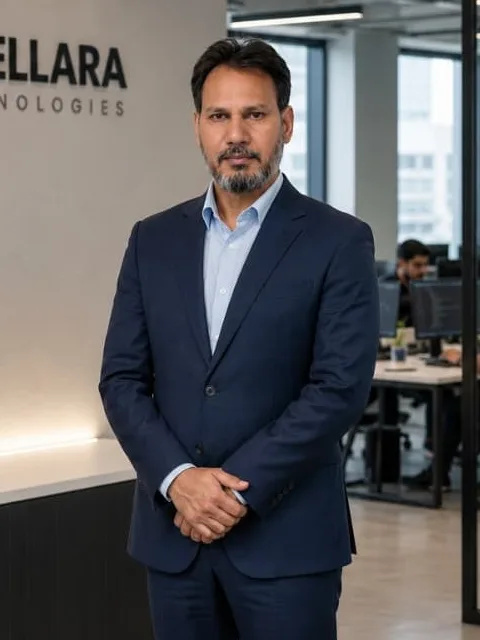
The founder
Dinesh Sharma
Founder and CEO, Intellara Technologies · Creator of troveGEN
Dinesh has spent more than 23 years building technology that large organisations depend on. He has designed and moved enterprise systems to the cloud, and he built a team of Microsoft Azure experts along the way. He holds the Microsoft Certified: Azure Solutions Architect Expert and AWS Certified Solutions Architect – Professional certifications, and his work spans multi-region, high-availability architectures on Azure, AWS and GCP.
Then he asked a different question: what if that same depth went into products that make knowledge easier to trust? That question became Intellara, and troveGEN is its answer for documents: a platform that turns an organisation’s own documents into answers with citations, so people can see where each answer came from.
Dinesh still designs and builds hands-on. He applies the same thinking to every client deployment, from AstroReeti, an AI astrology platform whose guide Reeti answers from classical texts, to the teams now building on troveGEN.
How he thinks about AI
Trust comes before cleverness.
An answer that cannot point to its source is not useful, so troveGEN is built around grounding and citations.
Retrieval decides quality.
Finding the right passage matters more than using a bigger model.
Your data stays yours.
The same platform should run in the cloud or inside a customer’s own infrastructure.
Use AI where it helps, and rules where they are better.
Predictable logic handles what must be consistent, and language models handle what must be understood.
What we believe
Four rules we build by.
They are why the product looks the way it does, and the first thing to check us against.
Measure it, do not assume it
A change is good when it improves results on documents like yours. The evaluation tools ship inside the product for the same reason we needed them: a score on someone else’s corpus tells you nothing about yours.
Nothing is locked in
Your vector database, your embedding model, your language model and your keys are connections you own. Moving between hosted and self-run is a setting, not a rewrite.
Claims you can verify
Every capability on this site ships today and can be tried on a free account. If a claim does not hold for your documents, tell us and we will correct it.
Protect first, then index
Sensitive values are replaced before anything is embedded or stored, credentials are encrypted and never returned, and deleting a document removes what was derived from it, with a receipt.
Trust
How your data is treated, and how to get the best results.
What we do with your data today, and how to get the most from the platform.
WHAT WE DO TODAY
- Credentials you store are encrypted at rest and never shown again by the API.
- Sensitive values such as account numbers and national IDs are replaced with tokens before indexing; the originals sit in a separate encrypted vault.
- You choose where your vectors live: in your own database, or hosted for you with a dedicated schema and vector namespace.
- Deleting a document removes its passages, vectors and derived data, and you get a receipt of what was removed.
- A fully air-gapped install is a supported mode, not a workaround.
GETTING THE BEST RESULTS
- Security reviews are welcome: ask us for the questionnaire answers and the controls you want to test.
- Eighteen languages are verified end to end, across nine scripts. Chinese, Japanese, Korean and Thai are not supported yet; everything else described on this site is supported today.
- For the best scan results use a sharp 300 dpi page; the console flags any text it is unsure about.
- For cross-language questions (for example English about a Hindi document) use the higher-accuracy model with reranking.
The company
Intellara Technologies
- AI-native product studio building domain-intelligent systems: retrieval pipelines, language-model platforms and knowledge-intensive products.
- Bengaluru, Karnataka, India. Founded 2025. DPIIT-recognised startup.
- AstroReeti, an AI-native Vedic astrology platform answering from classical texts in many languages, is a troveGEN client in production and the place where many hard lessons were learned.
- troveGEN is the retrieval stack built from that work, made general and offered to every team.
Talk to us.
Questions about a sovereign deployment, data residency, a security review, or whether troveGEN fits your documents? We would rather have the conversation than have you guess.